
Overview
This project was on a council estate in central London. The council estate management team made it almost impossible for us to set up a food growing space, even though in their public literature they said how great they were at providing food growing spaces for tenants. So after almost two years of failing to make any headway, a group of residents decided to do it on our own in a private garden within the estate. We approached a friend who was living with an octogenarian who we knew had loved gardening when he was younger, and he very happily invited us to use his garden.
The majority of the people who were interested in getting involved had no idea about growing food, so teaching became the priority.
Choosing a Methodology
I was not so familiar with OBREDIM so I decided to give this methodology a try. I cannot justify using it for any reason other than wanting to experiment and see what its strengths and weaknesses are. Testing a methodology on a real project is an effective way to learn it.
Working Through the Methodology
Observation
Patrick Whitefield's 4 Ways of Observing
I started my observation by using Patrick Whitefield's four ways of observing method, from which I extracted the following:
Intuitive — What are your first impressions of the site?
Overall feel: Barren. Unprotected.
Senses (eyes closed):
Hear: Neighbours; Cars
Smell: Neighbours cooking
Feel: Wind
Relationships with neighbouring land:
No border on south side — neighbours want to build a big fence
Road to north — noisy and polluted; pedestrians walk by; main estate through traffic
House to west — 8-storey building
Road to east — car park; not through traffic
Objective — Observe the site rationally and systematically
Soil type: Stony and poor quality
Climate / micro-climate: Exposed to southerly and northerly winds
Water courses and features: None; no water catchment surfaces
Plants: Only grass
Animals: Birds
Imaginative — How might this place change over time?
3 months: Overgrown grass
6 months: Longer grass; pioneers such as dandelion
Without human influence: Scrubland
Reflection: No diversity; only grass; not much insect life
Subjective — Genius loci
Imposing building; exposed all round; open to walkers by. The design would need to create a sense of shelter and enclosure to make this feel like a genuine gathering space.
PASE of What Exists
Plants: Grass
Animals: Birds occasionally
Structures: Flat with west-facing window; wall to north with a fence near the house; short wall to east beyond which are cars
Events: A bin in the garden — the only regular use. In the past the owner used to grow veg in the bed under the windowsill.
PASE of What the Client Wants
Looking through the methodology I could not find an obvious place to add what the clients want, so I have added it here.
Plants: Herbs; annuals; small shrubs; fruits; salads
Animals: Bees; lacewings; ladybirds
Structures: Seats; food growing beds; compost; winter seedling space; water butts; storage
Events: Gatherings (friends sitting around chatting); harvesting; tea parties
Basemap
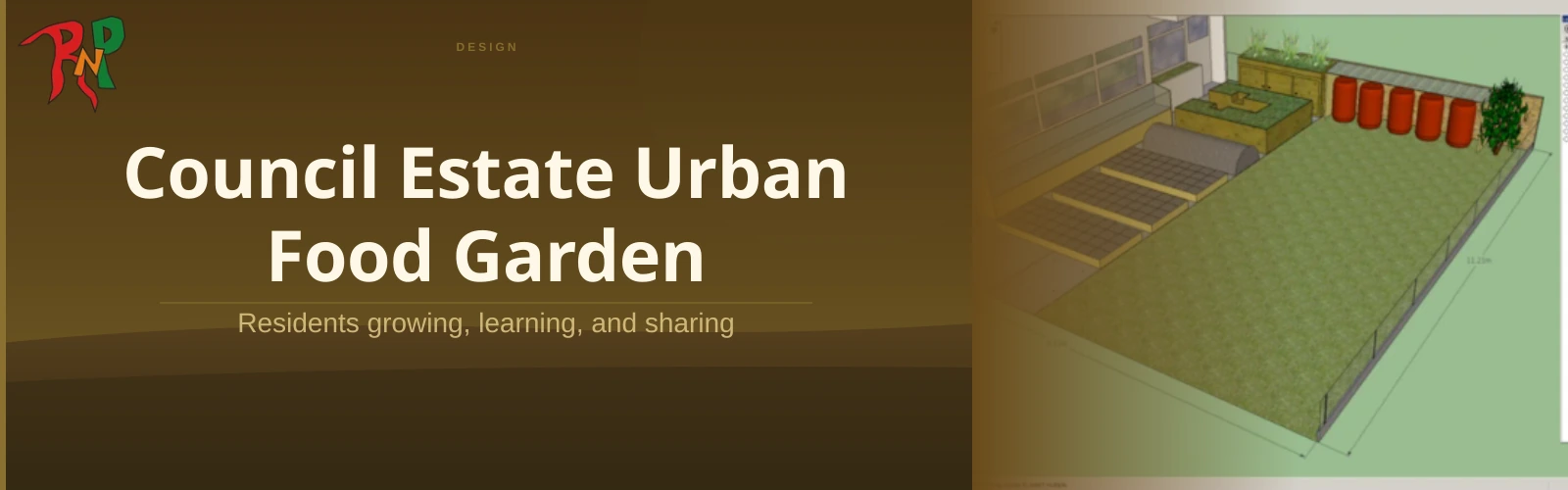
I used Google Sketchup to make a 3D model of the site.

Sun and Shade Maps
Here are the sun and shade maps taken at the spring and autumn equinoxes and summer and winter solstices, modelled at four times of day each.


You can also view the full animated sequence:

Boundaries
Physical Boundaries
South: No border — neighbours want to build a large fence
North: Road — noisy and polluted; pedestrians walk by; main estate through traffic
West: House — 8-storey building
East: Road — car park; not through traffic
We are not allowed to grow anything in the grassy area. We are confined to growing where the paved area is.
Other Boundaries
Lack of knowledge about food growing among participants.
Site is exposed — shelter is required before comfortable use is possible.
Resources
Money: £200 from a charity supporting the owner
Seeds and cuttings: From my own garden
People:
— Owner in his 80s: enjoyed gardening but cannot do physical work; happy for others to garden for him
— Transition Pimlico food group members: no growing skills but a strong desire to learn
The key resource we had was food growing knowledge and skill. The key need to be filled was the residents' desire to learn. So the design needed to consider how we could harvest as much learning as well as food.
Evaluation
Sun and Shade Analysis
Here we can see the sun and shade path for the day. Typically in this place the shade appears on the paved area from just after midday, which means we only have morning sun. The owner confirmed his observations of the sun and shade cycle, which was very close to the Sketchup models. For growing food on this site we need to take into consideration that it only gets half a day's sun.
Zones and Sectors Analysis
The following maps show my zones and sectors analysis. We can see where the main winds come from as well as which zones I perceive there to be. Because the site is so small, the space immediately outside the back door is zone 1 and the rest is zone 2. We are not allowed to grow anything on the grass so I did not label this — though you could say this is a zone 5 (wild zone), but given that grounds maintenance staff cut the grass so often it is not really a wild zone.


Plants
Many of the currants and berries will thrive in half a day's sun, as will many alliums, lettuces and similar crops. Of the original list of plants people said they wanted, many of the trees and bushes are not appropriate due to size and available sunlight, so we need to accept we cannot grow everything from the original list.
Having said that, the main point of this design is for people to learn. It may sound unconventional, but I for one learn a lot by making mistakes. With that in mind, I will consider allowing people to experiment even if I know it may not work, so we can discuss things afterwards and harvest some deep experiential learning. Some of the key things I would like to teach people is about the importance of putting the right plant in the right place — size, positioning, amount of sunlight, companion planting, and so on. I am therefore considering teaching these ideas through the square foot gardening technique. To further the education I will also consider making a hugelkulture, which will show how nature can create its own nutrients.
Soil Quality
The soil quality is very poor — it has been paved over for perhaps 70 years, so nothing will grow here except very hardy pioneer weeds. We need to improve the soil quality by adding organic matter and growing a succession of pioneer plants through to herbaceous plants, which will slowly add life back to the soil. This, however, will take a long time (one full year minimum), and given that we have eager students wanting to learn about food growing, this will be too long for them to wait. So in order to prevent them from walking away and thinking permaculture takes too long, I apply the obtain a yield principle, which led me to think we should aim for a yield in the first year. The only quick solution was to buy some compost or soil.
Unfortunately this is not entirely environmentally friendly, so in order to weigh up whether we should do this, I walked the students through a SWOC analysis:
SWOC: Should we buy compost / soil rather than create soil?
Strengths
Can begin growing much faster — this season (score: 4)
Gives people the opportunity to learn (score: 4)
People won't walk away thinking permaculture takes too long (score: 4)
Weaknesses
Needs fossil fuels to make and transport the store-bought compost (score: −4)
This compost is lifeless (score: −2)
Opportunities
To teach about food growing (score: 3)
Can teach about soil regeneration via the hugel (score: 3)
Can add life to the store-bought compost (score: 2)
Challenges
No challenges identified
Result: Strengths + Opportunities = 20 | Weaknesses + Challenges = −6 | Net = +14
The strengths and opportunities far exceed the weaknesses and challenges.
The next decision was where to source the compost from. We walked the students through a PMI (Plus, Minus, Interesting) to weigh up the options:
PMI: Where should we buy compost from?
Local hardware store
Plus: Shop is local — keeps money local and we don't need to travel far or use fossil fuel to collect
Minus: Compost came from far away and consumed a huge amount of fossil fuel; unlikely to be peat-free; usually a single sterilised batch — no life and little variation of nutrients
Superstore
Plus: Cheap
Minus: Compost came from far away and consumed a huge amount of fossil fuel; unlikely to be peat-free; same sterilised-batch issues
Local council recycling centre
Plus: Local; all material collected locally; recycled local garden waste; peat-free; varied material from hundreds of different gardens
Minus: We need to drive there — some fossil fuel use (but the centre is less than 2 km away)
Garden centre
Plus: Can get better quality compost; can find peat-free options
Minus: Compost came from far away and consumed a huge amount of fossil fuel; expensive; same sterilised-batch issues
Decision: We all agreed the best place to buy compost was from the local recycling centre. This was a nice exercise for the students in thinking about where consumable products come from and how to make decisions about the least environmentally destructive choice.
Design
The design process was quite straightforward. We made a map and cut out shapes to represent the different elements we wanted. We then moved things around and discussed the pros and cons of putting each element in different places. I then took my principle cards and turned them over one by one, asking people to think about the implications of each principle.
Raised Bed–cum–Seat–cum–Storage
Using the principle of each element performing multiple functions, we looked at how to make spaces multi-functional. This is how we came to the conclusion of making a raised bed that also contains a seat and has storage space underneath. Given that this is raised and we do not want it to cast shade on the food growing plots on the ground, the most logical place for this structure was to the north.

More Storage Space
We also added a storage space for larger and more valuable items. We decided this should be as close to the house and back door as possible, hence we moved it north of the seats.

Square Foot Beds and Hugel Bed
We calculated the optimum size of the square foot beds (4 ft wide × 9 ft long), which left 1 ft between beds, plus enough room to make a hugelkulture of just over 1 metre. Given the hugel would be the tallest of the beds and therefore cast the most shadow, we placed it at the back.

Compost Bins and Cloche
The compost bins had one realistic place to go, as the owners did not want them under the windows or near the door. This left the length of the wall under the windows for a cloche. Running the design through the principles — particularly each element performs multiple functions — we came to the conclusion of making it a cloche–cum–greenhouse–cum–table–cum–storage space. Glass can be added to the frame (top and front) to make it a greenhouse, or removed to use it as an open table. It was designed so that sections could be covered or open independently, giving flexibility across the seasons. The following picture does not show the full extent of the cloche design, as at this point we had sketched the pattern and later filled in the details without updating the Sketchup design.

Water Collection
The most interesting part of the design was working out where to get water from. There are no flat surfaces or downpipes from the building, so we had to make one. The only space left was the grassed area, which technically we were not supposed to encroach on. We decided that if we made it easy to move, we would be okay — and if asked to move it, we could remove the storage by the door and place the water capture system there instead. The design was quite simple: we bought some water barrels and built a roof from a polycarbonate board. The water caught was channelled into the first barrel, which overspills into the next and so on. The final overspill we decided should go to the base of the hugel. We made sure to position a tap high enough on the barrel that we could water the raised bed without needing a pump.
Design Progression
The following sequence shows how the design was built up layer by layer:


Final Design

Planting Plan
Designing the planting plan was great fun. I gave everyone a guide to square foot gardening, including a list of plants and how many could fit into one square foot. I also gave them a guide to companion planting. They then went away and three out of four of them made a planting plan. The final plot we left empty for experiments and spare plants that emerged.

Implementation
Implementation Plan
The plan was to start with the easy-to-build sections and slowly build up to the more complicated elements. In the first year we decided to make the beds, the rain capture system, and get the compost going. Over winter or the following year we would start building the storage spaces, the seated raised bed, and the cloche. This felt like a realistic use of our time and energy.
What Actually Happened
The first things to arrive were the compost bins. I gave a short talk on composting and how to make good compost, and we finally had somewhere on the council estate where we could throw our organic waste. Then we took up the paving slabs and built the square foot beds. We used timber salvaged from a skip and threw in as much organic matter as we could find.
At the same time as making this garden, we were also making a nature garden on the estate, so we had access to a lot of organic waste materials. We were also very friendly with the gardening contractors, who gave us lots of spare materials. Most of the plants we grew ourselves from seed or cuttings. I ran sessions on making paper pots and different ways of starting seedlings, as well as a session on taking cuttings. Everyone got involved, and while we were waiting for the beds to be finished we all grew various plants in our houses.
We used the grant to buy some compost and a few herbs and shrubs. We also procured the materials to build the water capture system (deemed the next most important element). The veg in the beds and the hugel started growing well, and everyone was excited. It was a lovely atmosphere, and we were enjoying our time together — but then I had to leave rather suddenly.
Maintenance & Evaluation
What Went Well
There was such a lively community spirit — it was great to meet so many lovely people and make things happen.
The level of sharing and learning that took place was very pleasing.
Making the square foot garden taught participants a lot about right placement and spacing of plants.
We had fun planting seedlings and taking cuttings.
The design process was also fun, as I made sure everyone was involved.
What I Would Do Differently
Choose a site with a more secure long-term future — though the person had been there 10 years, so we had no idea he would leave so unexpectedly.
Vision and Next Steps
If I had not been forced to move, I would have loved to keep working with this group. If I were around we could find another place and start again. We were also offered some more plots to work on, but decided it would be better to get one plot up and running and then take the lessons learnt before working on the next. With hindsight we could have at least started one more site, even if it were not as detailed — just to get it started and looking nice — so that when I left and the owner moved away, the group could have redirected their energy there.
Evaluating Through the Ethics
Earthcare: We took a barren, lifeless, concrete-paved area and for the duration of this project brought it to life. Bees, butterflies, and compost worms all appeared spontaneously. We created a nourishing environment rather than destroying one.
Peoplecare: This was mainly about people care. It was all about teaching people how to be more self-sufficient and showing the benefits of coming together to help each other.
Fairshare: The surplus in this case was the surplus of knowledge — those of us with knowledge of food growing or building shared it with others. Given more time, I am sure we would have collected fruits, food, seeds, and mulch material and reinvested them where appropriate.
Summary
Sadly my father passed away before we could harvest most of the crops. I had to move away from this location and so was not able to keep up with the project. When I returned the following year, I was told the owner had moved out of the house for health reasons. The estate management then promptly destroyed all our beds and returned the space to pavement and grass.
However, the people who had been helping said they did get a great yield from the beds and learned a lot about food growing in that one season — and several have gone on to grow plants at home on balconies and in containers. So while the project was not long-lived, we had fun and several people gained lasting knowledge of sustainable food growing.
On reflection, perhaps we would have been better off continuing to work with the estate office. It may have taken another year for them to fulfil their promises, but at least the site would have been secured. We put all our eggs in one basket, and when we lost that site, the whole project collapsed.