
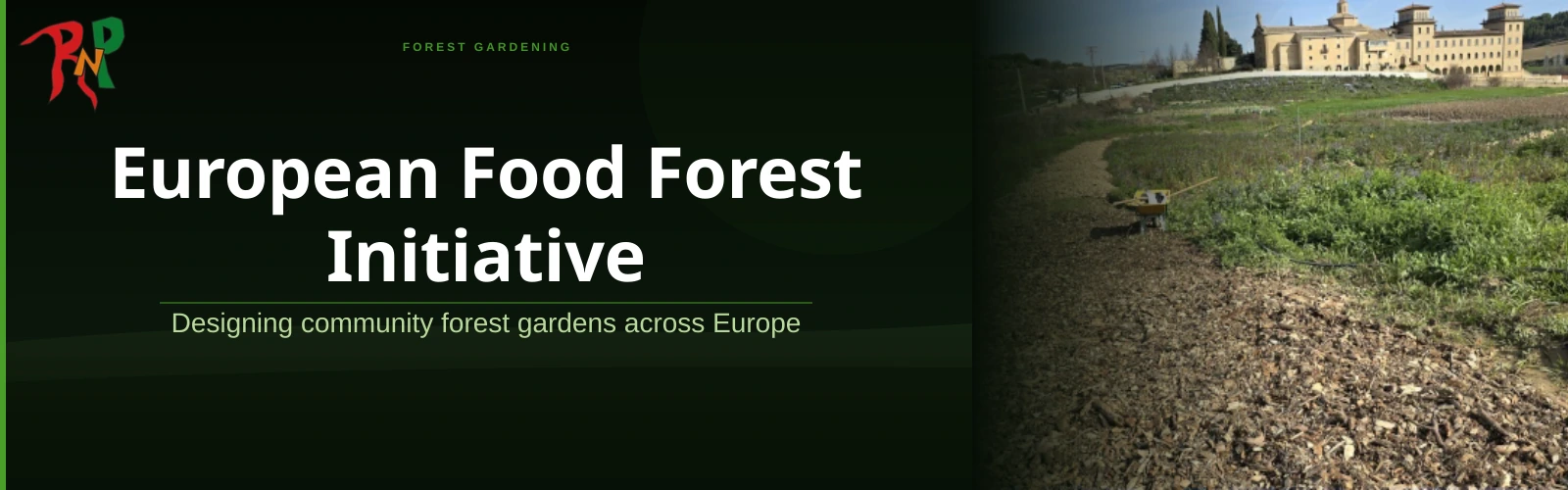
Designing community forest gardens across Spain and Estonia
While teaching an advanced forest garden course in the Netherlands in 2024, one of the participants, a university professor leading a new European food forest initiative, joined the class. She had heard about my work and wanted to see how I taught and shared forest gardening in practice. Over the course of the workshop, she was convinced that my approach (making complex design principles accessible, practical, and hands-on) was exactly what was needed for the project. This led to my being invited to take on the role of lead designer and trainer for the first two years of this European Food Forest project, supported by EIT Food.
It was a unique opportunity: a chance to bring my experience in designing and implementing forest gardens to a larger scale, across different countries and climates, and to contribute to a project with the potential to influence how community food forests are understood and supported across Europe.
What is the European food forest project?
At its core, this project is exploring a simple but important question:
What does it actually take to establish food forests as a meaningful part of our food systems in Europe?
The project begins with the creation of two community food forests. One in Artajona in northern Spain and one in Tallinn in Estonia.
These sites will act as pilot community forest gardens. Real places where permaculture design, ecology, and community come together in practice. From there, the intention is to support the development of further sites, contributing to a wider European network of community food forests.
Alongside the physical spaces, the project brings together education, research, and practical experimentation. Working with schools, local communities, growers, and organisations to explore how these systems function across different climates and cultural contexts.
What is a food forest?
A food forest, also known as a forest garden, is a way of growing food inspired by the structure and relationships found in natural woodland.
Rather than a single layer of crops, a food forest is designed with multiple layers: canopy trees, fruit trees, shrubs, herbs, ground cover, climbers, and roots all interacting as part of a living system.
Beyond structure, it is about relationships: between plants, between soil and water, and between people and place.
Designing a food forest using permaculture principles means working with time, succession, and ecology. It is not just about producing food, but about creating spaces that support community cohesion, learning, and collaboration. The system is guided to establish and evolve naturally, rather than being rigidly controlled, allowing people and plants to grow together.
Lead designer role in a European forest garden project
My role within this project is to lead on permaculture design and contribute to training. Working alongside partners and communities to shape both the physical spaces and the learning that happens within them.
I have been designing and implementing forest gardens for many years. What drew me to this project is the scale at which this work is taking place and its potential to influence how food systems are understood and supported across Europe.
There is also the opportunity to contribute to conversations that may shape future policy. Exploring how food forests can move beyond small scale examples and become a recognised and supported approach within wider agricultural and land use systems.
Working across different climates and cultural contexts adds another layer to this process. What works in northern Spain will not translate directly to Estonia, and part of the work is understanding how these principles adapt to place.
Community food forests, education and research
While the visible outcome of the project will be the establishment of food forests, there are several deeper strands running through it.
One is education. These community food forests are intended not just as productive landscapes, but as places of shared learning. Working with schools, students, and local communities to build understanding around food systems, ecology, and land stewardship.
Another is ongoing inquiry. Through observation and participation, the project will explore how food forests function socially, ecologically, and economically in a European context.
There is also a more challenging question around viability. If food forests are to move beyond small scale or experimental projects, they need to be workable for the people involved in managing them. Practically as well as economically. This is something the project will explore rather than assume.
Starting a food forest project in Europe
The sites are in development, relationships are forming, and many decisions are still unfolding. As with any project working with living systems and communities, there are unknowns, but this uncertainty is also exciting: it allows the project to evolve in ways we may not yet anticipate and to grow in response to the people and ecosystems involved.
Follow the food forest project
Over the coming months and years, I will be sharing updates from this project. Following its development in Spain and Estonia, and reflecting on what works, what does not, and what we learn along the way.
Rather than presenting a finished model, the intention is to document a living process. One that others can learn from, question, and adapt to their own contexts.
If food forests are to play a meaningful role in future food systems, it will be through this kind of grounded and iterative work.
This is where that begins.
Get involved in forest gardening
If you are interested in creating a community forest garden, or want to learn more about forest gardening and permaculture design, feel free to get in touch.
You can also explore more about forest garden design and how these systems can be applied in your own context.
What Participants Say
"Thank you Rakesh. I've loved your questioning style, rich content, and laid-back delivery on your forest garden course. It really has been an enlightening learning experience for me. Now, 8 weeks later, I feel equipped with all the resources I need (including lots of inspiring new friends from all over the world) to design my own food forest(s), and look forward to keeping in touch with you and the whole Roots n Permaculture community to see where this forest garden revolution takes us :)"
Upcoming Courses & Workshops
Explore upcoming sessions and find something that fits your interests. If you don’t see a course that works for you, feel free to get in touch to express interest or organise a session in your area.
Upcoming Course Dates Forest Gardening
| No events |
Other Upcoming Courses
| 14 Jul 2026; 09:00AM - 06:00PM 12 to 17 day Urban - Vegan - Permaculture Design Course with an emphasis on Designing for Kids |