
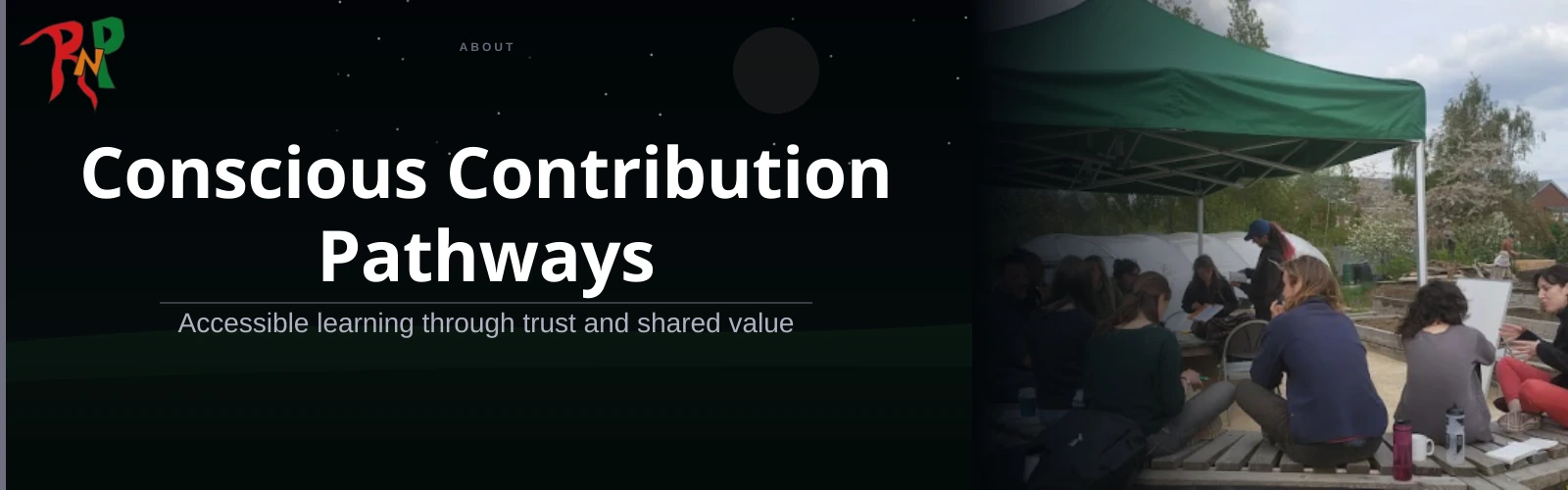
The Conscious Contribution model is designed to make regenerative learning accessible, inclusive, and grounded in trust rather than financial pressure.
At Roots n Permaculture, we recognise that people come from many different income streams, life situations, and financial realities. Fixed pricing can unintentionally exclude, or create feelings of pressure, guilt, or embarrassment. This model seeks to remove those barriers and replace them with trust, transparency, and shared responsibility.
Why accessibility matters
We are living in a time where ecological understanding, practical skills, and regenerative thinking are not luxuries, they are essential. The challenges we face are shared, and the knowledge needed to respond must be widely accessible.
When learning is restricted by fixed pricing, it often excludes those who may benefit most, or those already working at the edges of community, land, and social change. This creates an imbalance where access to knowledge is shaped by financial privilege rather than genuine need or commitment.
Money, while necessary in the current system, should not be the primary gateway to learning, especially when it comes to environmental awareness and regenerative practice. If access is limited, then the capacity to respond to ecological and social challenges is also limited.
At Roots n Permaculture, we recognise that people contribute in many ways, through time, energy, care, skills, lived experience, and presence. Financial contribution is only one part of a wider exchange.
The Conscious Contribution model is a response to this. It creates learning spaces where financial limitations do not prevent participation, and where those who are able to give more can help support wider access for others.
Rooted in permaculture ethics
This approach is grounded in the ethics of Earth Care, People Care, and Fair Share.
- Earth Care supporting more people to engage with land-based and regenerative practices
- People Care removing barriers so individuals can participate without stress or exclusion
- Fair Share redistributing resources so that surplus can support wider access
Rather than treating education as a commodity, this model sees it as a shared resource that can be stewarded collectively.
A flexible approach to contribution
Instead of a single fixed fee, participants are invited to choose what they contribute from a guided range:
- Lower contribution for those with limited income or financial pressure
- Mid contribution (ideal) the amount that fairly supports the running of the course
- Upper contribution for those who are able and wish to support others more generously
This range allows people to participate in a way that feels honest and appropriate to their circumstances.
If someone is unable to afford even the lower end of the range, we encourage them to get in touch. Through a simple conversation, we can usually find a way forward that works for everyone involved. No one should feel excluded due to finances alone.
Shared food culture
Food is an important part of the learning experience and community connection.
On short courses and non-residential gatherings, we often use a potluck approach. Participants bring and share what they can. This creates a rich, diverse, and communal experience while reducing financial pressure on individuals.
On longer courses, we use a more collaborative approach informed by sociocracy. Food arrangements are discussed and agreed through participatory decision-making, ensuring the group has a voice in how shared resources are organised.
In many situations, we also use the “magic hat” system, where people contribute what they are able towards shared food costs. This keeps things simple, flexible, and rooted in mutual trust.
Accommodation and staying options
Where accommodation is needed, this is arranged directly with local hosts. We aim to negotiate a range of options wherever possible to keep costs accessible and varied.
By working closely with hosts, we try to ensure there are choices that suit different budgets while maintaining comfort, safety, and proximity to the course location.
The wider intention
The Conscious Contribution model is more than a pricing structure. It is part of a wider cultural shift. It challenges the idea that value is fixed or purely financial, and instead explores how learning can be supported through relationship, trust, and shared responsibility.
When people contribute at different levels, they are not simply paying for a course. They are participating in a system that allows knowledge to circulate more freely and reach further into communities.
This approach is not perfect, and it requires honesty and care from everyone involved. But it creates the conditions for something more balanced, where access is widened, pressure is reduced, and learning becomes something we hold together.
An invitation
If this approach resonates with you, you are warmly invited to join, participate fully, and contribute in a way that feels right for your situation.
If finances are a barrier, please get in touch. We are always open to finding a way that supports your participation.
Upcoming Courses & Workshops
Explore upcoming sessions and find something that fits your interests. If you don’t see a course that works for you, feel free to get in touch to express interest or organise a session in your area.
Other Upcoming Courses
| 14 Jul 2026; 09:00AM - 06:00PM 12 to 17 day Urban - Vegan - Permaculture Design Course with an emphasis on Designing for Kids |