
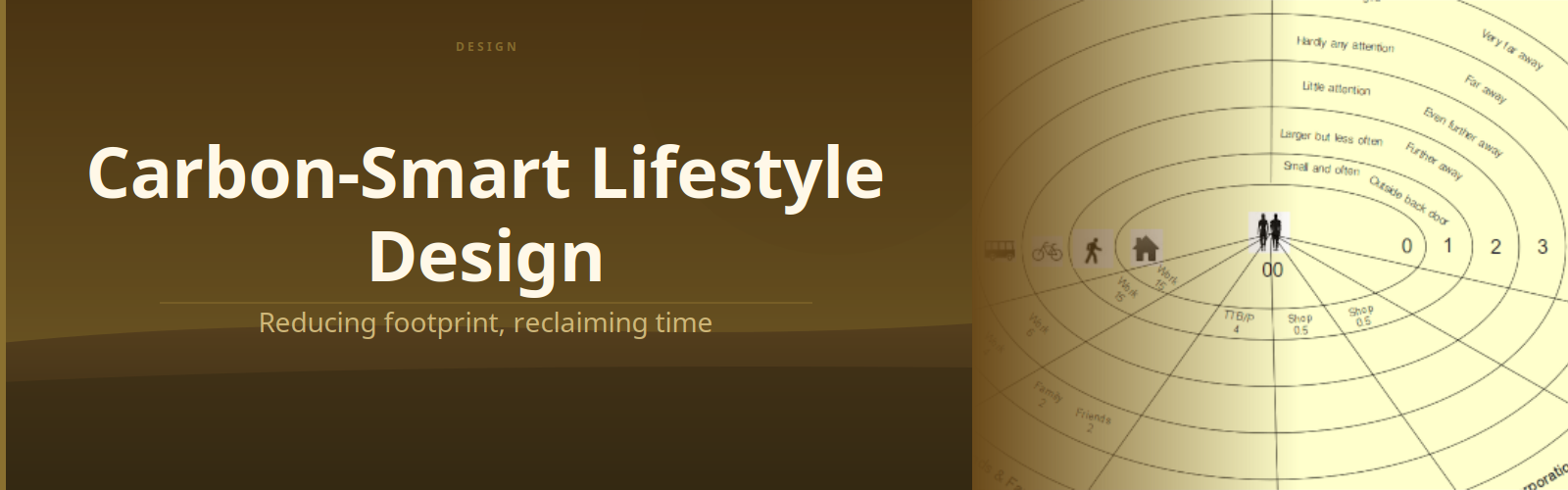
Carbon-Smart Lifestyle Design
Overview
This design began as a focused exercise in reducing my carbon footprint — specifically looking at how my use of fossil fuels could be reduced. It evolved into something considerably larger: a design for how to make better use of my time and energy as a whole, and ultimately helped identify when the right time was to transition to full-time permaculture work.
Initially informal, the project was formalised using CEAP (Collect, Evaluate, Apply, Plan). This demonstrates how permaculture tools can be creatively applied beyond land design to optimise urban lifestyle and personal energy use.
Permaculture tools are not only for gardens and land. Zones and sectors — typically used to understand land use around a home — can be reinterpreted to map any kind of human activity. This design shows how to use them to audit and redesign a travel and social life.
Methodology
Initially no methodology was used, as the project started as an informal exercise. Once recognised, CEAP was chosen: the information collection was already substantially complete, and CEAP's lighter structure was appropriate for a personal, non-land-based design.
Working Through the Design
-
Collect — Urban Zones & Sectors Analysis
Zones were mapped by transport energy efficiency, and sectors were categories of activity. This produced a map of where time and carbon were being spent, and became a teaching tool in PDC sessions.

Urban zones & sectors analysis — the adapted tool applied to travel and lifestyle -
Evaluate — Making Sense of the Data
The evaluation stage identified inefficiencies and opportunities. Activities generating the highest carbon but providing least value were prioritised for change.

Evaluation mind map -
Apply — Principles & Design Solutions
Permaculture principles were applied to generate actionable lifestyle changes and optimise personal energy use.

Applying permaculture principles 
Summary of design solutions -
Plan, Implement & Evaluate

Implementation plan 
Implementation plan (Xmind)
Reflections & Outcomes
The project successfully reduced personal carbon footprint, reclaimed time, and guided a transition to full-time permaculture work. Urban zones and sectors tools developed here continue to serve as teaching resources.